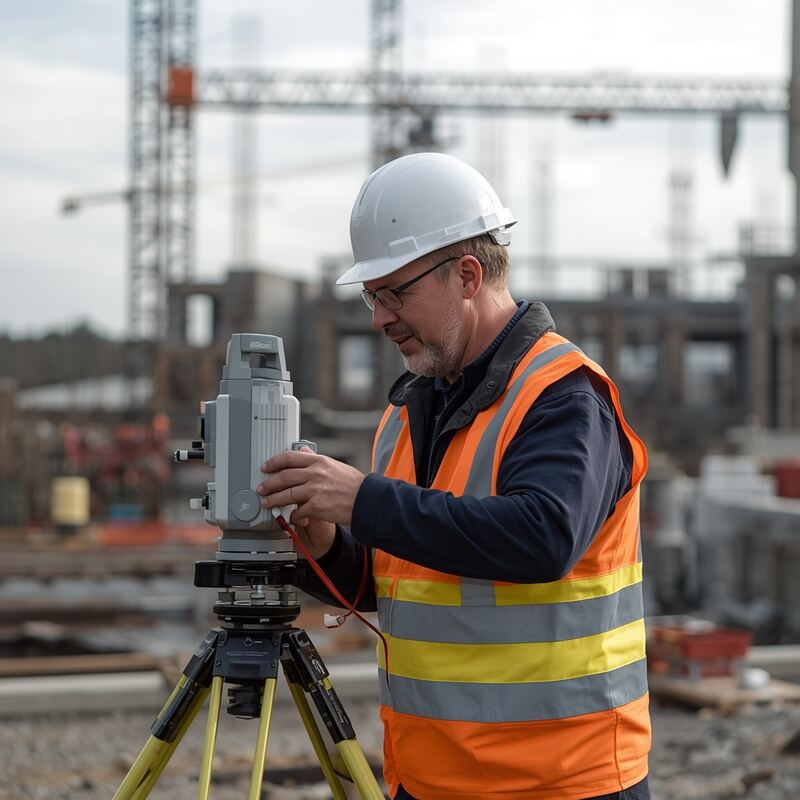
If you're a Site Engineer working in Ireland right now, there's a reasonable chance you're being paid less than the current market rate — not because your employer is being unfair, but because most people simply don't check. Salary conversations happen once a year, if that, and the market moves faster than most people's awareness of it.
The Dublin Range
According to the Regional Construction Salary Guide 2026, Site Engineers in Dublin currently sit in a €60,000–€75,000 range, depending on experience and the scale of projects you've worked on. The midpoint — a useful single number if you need one for a conversation — is €67,500.
How Experience Changes The Number
The Dublin range above is a blended figure for working Site Engineers. Other 2026 guides split it by experience, and the early-career numbers are lower. Sigmar Recruitment's 2026 guide puts Dublin Site Engineers with 1–3 years at €35,000–€40,000, with 3–5 years at €45,000–€60,000, and with 5+ years at €65,000–€75,000+. Brightpath's guide is similar for juniors (€35,000–€40,000 in Dublin) and reaches €70,000–€85,000 at senior level. If you're earlier in your career, compare yourself to the band that matches your years, not to the headline range.
It's Not The Same Everywhere
Outside Dublin, the range shifts down — typically to around €55,000–€65,000 in the North West and North East, with most other regions (South, South East, Midlands, Midwest, West) sitting closer to €60,000–€70,000. That's a real, consistent gap, not statistical noise — Dublin pays more across the board for this role, reflecting both the concentration of larger projects and the higher cost of living.
What Actually Moves You Up The Range
Within any given region, the difference between sitting at the bottom of the range and the top usually comes down to three things: project scale (has your CV actually shown you working on projects of meaningful size and value, or does it read vague?), certifications (Safe Pass and Manual Handling are baseline — NEBOSH or a trade-relevant qualification signals you're ready for more responsibility), and how clearly your CV communicates ownership rather than just presence. "Assisted with quality control" reads very differently from "managed quality control across a 40-unit residential phase."
The Next Step Up
If you've got 3–5 years in as a Site Engineer, the realistic next role is Senior Site Engineer. Hays Ireland's 2026 guide puts Senior Site Engineers in Dublin at €65,000–€83,000, compared with €50,000–€65,000 for Site Engineers in the same guide. Salary guides measure the market differently — the Regional Construction Salary Guide above is higher for Site Engineers — so treat every range here as indicative, not exact. Moving up isn't automatic: it requires your CV and your interview answers to actually demonstrate the extra responsibility, not just the extra years.
Want to know exactly where you sit, based on your own CV — not just a general range?
Audit Your CV — €19 →The Dublin and regional ranges come from the Regional Construction Salary Guide 2026, and the Senior Site Engineer range comes from Hays Ireland Salary & Recruiting Trends 2026. The 12% comparison is our own arithmetic on those published figures. If you want the full 8-region breakdown across all construction and engineering roles, not just Site Engineer, the Salary page has the complete interactive dataset.